Monday, 20 December 2010

Busy times,,,

wow what a busy two weeks that was! but it doesn't stop there - there is lots of work to be done over the Christmas break and i have made my geeky timetable as long as i stick to it i could even have a couple of days off before we come back for term 2!!!

Over the past few weeks i feel as though my head has been split into 3-
History and Philosophy of Garden Design / Historic Garden Conservation / Master planning

Luckily we have completed, handed in our Historic Conservation Management Plan and its already marked! I am very pleased with my well earned A , and well done to the rest of the group who all worked really hard and too got great results.
All our work will be online soon- i will post the link once i have it- the online exhibition will be all the collaborated group work and the individual Historic Conservation Management Plans of Greenwich Park, London.

Here is a little part of my document: Vision and 3 of my Key Recommendations:
The Vision 
The vision for Greenwich Park is to emphasise education with the promotion of its diverse history.
As a world heritage site it is to be an example of educating the local , wider community and the
world of all the historic layers the park has: From the Anglo-Saxon Burial grounds to the Royal
Observatory – Greenwich holds examples of triumph and brilliance of each time period. With
the education will come the understanding of the importance of this site.
The park is to be an area of enjoyment, recreation and leisure for locals and visitors, with
appropriate amenities and areas for this.
The park is to demonstrate how to create areas that are beneficial to wildlife in the city with the
introduction of select habitat areas thus creating awareness and educating all about the issues
and importance of wildlife and habitats.
Visitors will once again feel that they are within a royal park.


Signs, Information and Educating

Due to the amount of visitors the park receives it is important that information is provided and is
accessible to all. This can be done with the use of interactive screens: with the interactive delivery
of the information will make it fun and engaging. It will take up less space and people can find the
information that they want, in their language. The screens can be put among sculpture (see below) to
integrate is as part of an historic landscape.
-Capturing the layers of history with framed views: a picture of the same view and how it has changed
through time- with the final frame empty to see its current layer.
-For children they can imagine how it might look in the next layer and can draw how they think it will
be in 100 years time.


 Framed views within and out of the park with information of what you see within the frame.


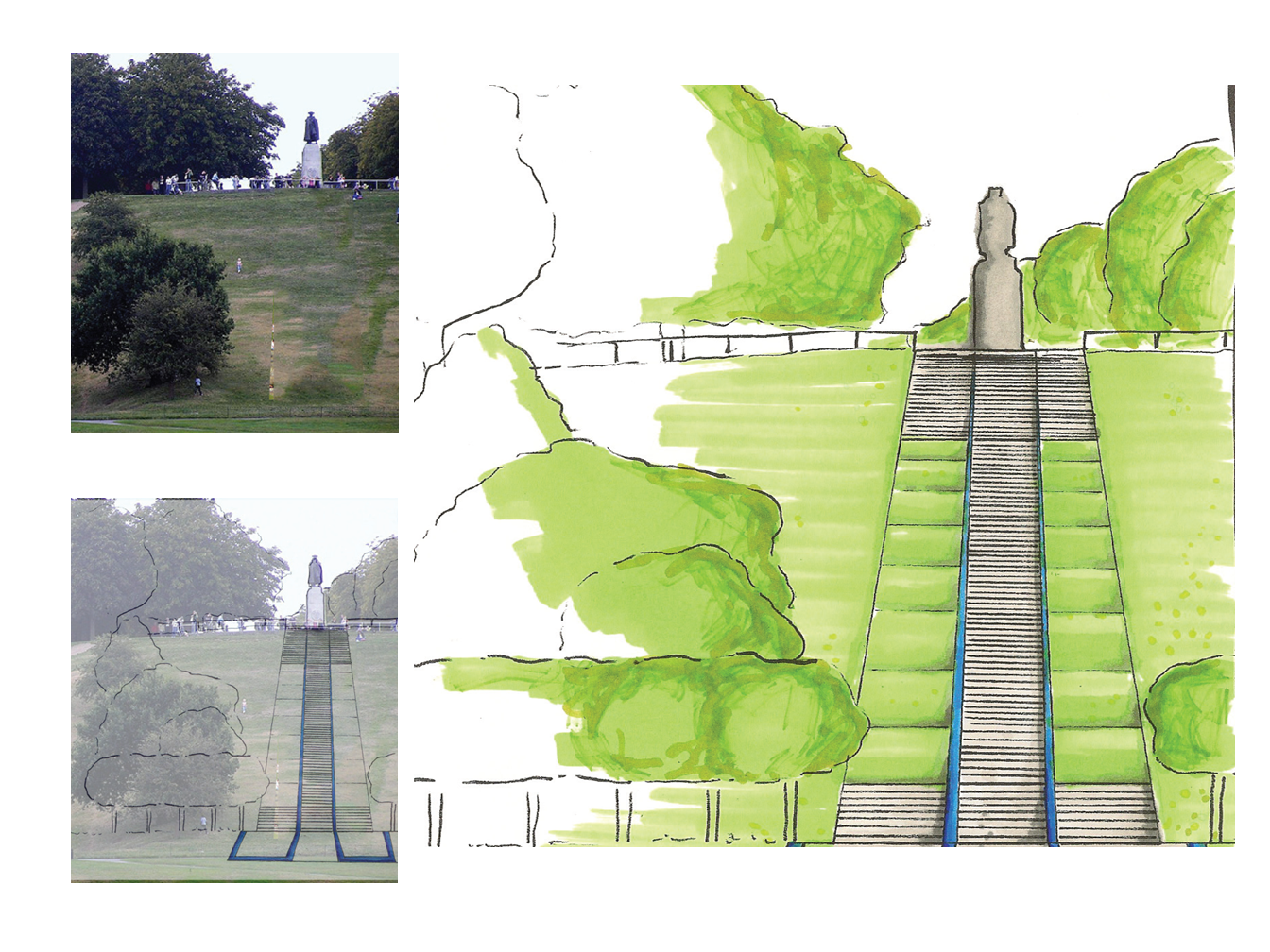
The Giant Steps

Le Notre (who never visited England) designed the grass parterre which were implemented
in 1662 and the giant steps that over looked it,the steps are shown in all 18th Century
prints of the park. The remains of the Giant Steps rise up to the statue of James Woolfe.
Each terrace was 40 yards wide, and on either side Scotch firs were planted 24 feet apart.
These trees were brought by General Monk from Scotland in 1664, and until forty years
ago many were standing.


The Meadow Walks

Areas where the Ancient acid grassland ispresent are being destroyed by the constant use of heavy machinery showing the lack of care and understanding of its importance.
Lowland Acid Grassland is an important habitat for nature conservation throughout the Greater London area. Lowland acid grassland develops on low-nutrient, acidic soils (pH 4 to 5.5) overlying acidic rocks or on the free draining, gravelly and sandy soils found in many parts of London. Grazing (or cutting) is needed to prevent invasion by scrub and trees this can be done once a year or every two years with the introduction of sheep for the grazing period.
The acid grasslands of Greater London, south Essex and north west Kent are an important home for a distinctive community of insects and spiders – many of which are nationally scarce.  This community is collectively known as the ‘Thames Terrace Invertebrates’.


3 main areas of acid grass land will be sectioned off and left to grow and develop naturally. With the help of reintroducing species that have been loft as a result of machine mowing. There will be allocated paths that wind through the grassland to give visitors the opportunity to walk amongst a UK Biodiversity Action Plan habitat. Information about the Flora and Fauna that can be seen will be at the entrances of the walks providing education and fun to a nationally important habitat resource. 

(I will post the link for the online exhibition soon.)

Saturday, 4 December 2010

snowed in!!

being snowed in has its advantages- it means i cant go to the allotment and lose hours there- when i should be getting on with my work, so i have managed to get lots done since the pretty white stuff fell-

-however i couldnt help myself- i had to go and see what the allotment looked like under the blanket of thick snow- it was beautiful!

here are some summer / winter  shots:


my favourite place to just sit and relax-(but not today!!)


the snow was very deep here in maidstone- or am i just very small??


we started a bonfire (any excuse) to keep warm, and i harvested some
brussel sprouts for dinner!


Oh summer days spent at the allotment- feels like such along time ago now,,,


Wednesday, 1 December 2010

Great Dixter Christmass Fair 2010

Great Dixter Christmass Fair 2010 was a great success, with hundreds of people coming to dixter over the weekend, to have a glass of spiced hot apple juice, see the garden and its winter structure and wonder around the house with all fires lit- doing their Christmas shopping with a vast range of stalls selling all sorts.
I bought chocolate (obvious to those that know of my sweet tooth!) , olive oil, bundles of wooden labels for the allotment/garden and a  fantastic wall chart designed by the charming Christopher Lloyd -(the great Christopher Lloyds nephew)

you may have already seen a much larger version of his wall book on the south bank, London:

 
  wallbook  happened
More info on these great books: http://whatonearthbooks.com/


Here are some of the pictures i took over the weekend:


 frosted sempervivum on the larder roof,

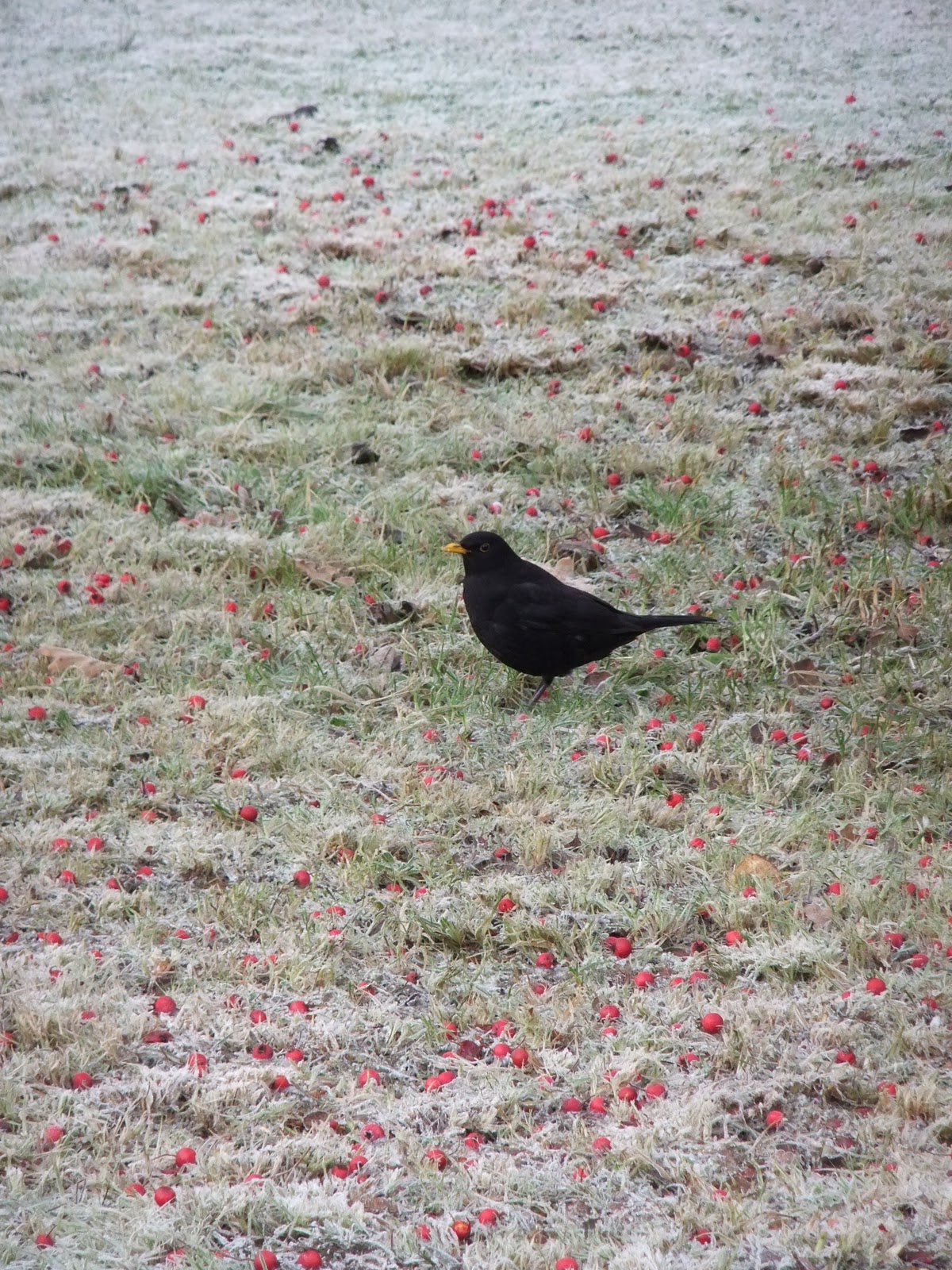
the kitchen drive , and a little black bird collecting his berries


frosted ferns and cotoneaster horizontalis are key in the garden at this time of year,

structural plants are left in the winter and here is a perfect example of why, teasel
are dotted around the garden for the winter structure,
the topiary adds to the permanent structure and is beautifully highlighted with a frost or snow,


.....and of course pics of little conifer,
a little bundle of loveliness!!


the frozen horse pond, with the Jurassic gunnera leaves

cotoneaster horizontalis and the peacocks highlighted by the frost,

the view from the top window of the house, looking
down over the topiary lawn and beyond,,,


(above pic:gardens illustrated.com)


the fair was also the launch of the new book, dear christo
a book by his freinds, a nice insight to the real christo,
out to by now-http://www.amazon.co.uk/Dear-Christo-Memories-Christopher-Dixter/dp/1604692235


Friday, 26 November 2010

Masterplan senarios - connective/ education/ alternative

 On Monday, the class brain-stormed 3 words-

-connective
-education
-alternative

These are our 3 masterplan scenarios- we now need to research their meanings and precedents further to understand them more and to be able to then put them in to a concept for a design for the park,

Here is what we all came up with as a class:


History - Calverley Grounds, Tunbridge Wells Kent

History - Calverley Grounds, Tunbridge Wells Kent

Here are my sections in the group survey document ,
I covered History of Tunbridge Wells and the Calverley Park, Archaeology,Ancient Monuments, Historic Scheduled Buildings and Historic Parks and Gardens.

We as a group have worked very hard to get this document up to scratch, we are to hand in the final document on Monday 29th Nov- fingers crossed !

We have already presented the site in the form of a power point presentation- we had Neil and Jim talk about the topography and hydrology as they are key physical feature of the site. 
We then wanted to really hone down on what we thought were the 3 most important factors of the site and its context-
-the history  - presented by myself
-the people  - presented by Sue
-the genius loci  - presented by Joey
-we then ended the presentation with a short film to capture the sense of the park  - made by Toby

We got good feedback overall for the presentation- to sum it up they would have liked about 10% more factual info to back up what we were saying.

I would like to say thank you and well done to everyone in the Tunbridge Wells group.