Here is the link to the online exhibition for Year 3 Garden Design, - Historic Conservation Management Plans and group project work on Greenwich Park, London.
http://blogs.gre.ac.uk/landscape/
Friday, 21 January 2011

Thursday, 20 January 2011
another pen technique?

pro marker pens on reverse,
take into photoshop and reverced back

then lay the out line on top,
then print

???? not sure
maybe if i do the skay after, so that it is bighter, and then add some pencil in the forground?
Wednesday, 19 January 2011
ink and pencil?
ink and pencil- still not enough atmosphere,,,,still not enough depth- going to have to keep working on this!!- ,, it certainly does stand off the wall now!


rendering styles- which one do i choose !!????
After Monday's pin up, it was obvious that the rendering style i chose was weak, it was lost on the wall, so iv tried afew more techniques- now i need to be brave , choose and apply one to all my work!! my main goal is to show atmosphere ? I'm not there yet but i hope can get there?
I would appreciate any feedback ( time permitting, of corse!)

Ink and a touch of pencil

 Ink
Ink
Pro marker pens

Colour pencil

Pencil led sticks

Pastels

Ink
Thursday, 30 December 2010
a very foggy calverley grounds - 29th dec
 Yesterday I went to visit Calverley Ground with my chosen design to see what will work, what wont- i found it really helped visiting the site again if not only to realise the scale again! We get so used to looking in plan form on A1 that you need to keep visiting the site to truly see if the design will work or not.
However yesterday was extremely foggy- it was a horrible slow drive there and back but the park had more people in it than i had ever seen there before!
-lots of puppies for Christmas in this town!
When i stood at the entrance of the park i could hardly see over to the other end, it was quite magical really. i am planning to go again once the fog lifts.
Here are some of the pictures i took yesterday:


Monday, 27 December 2010
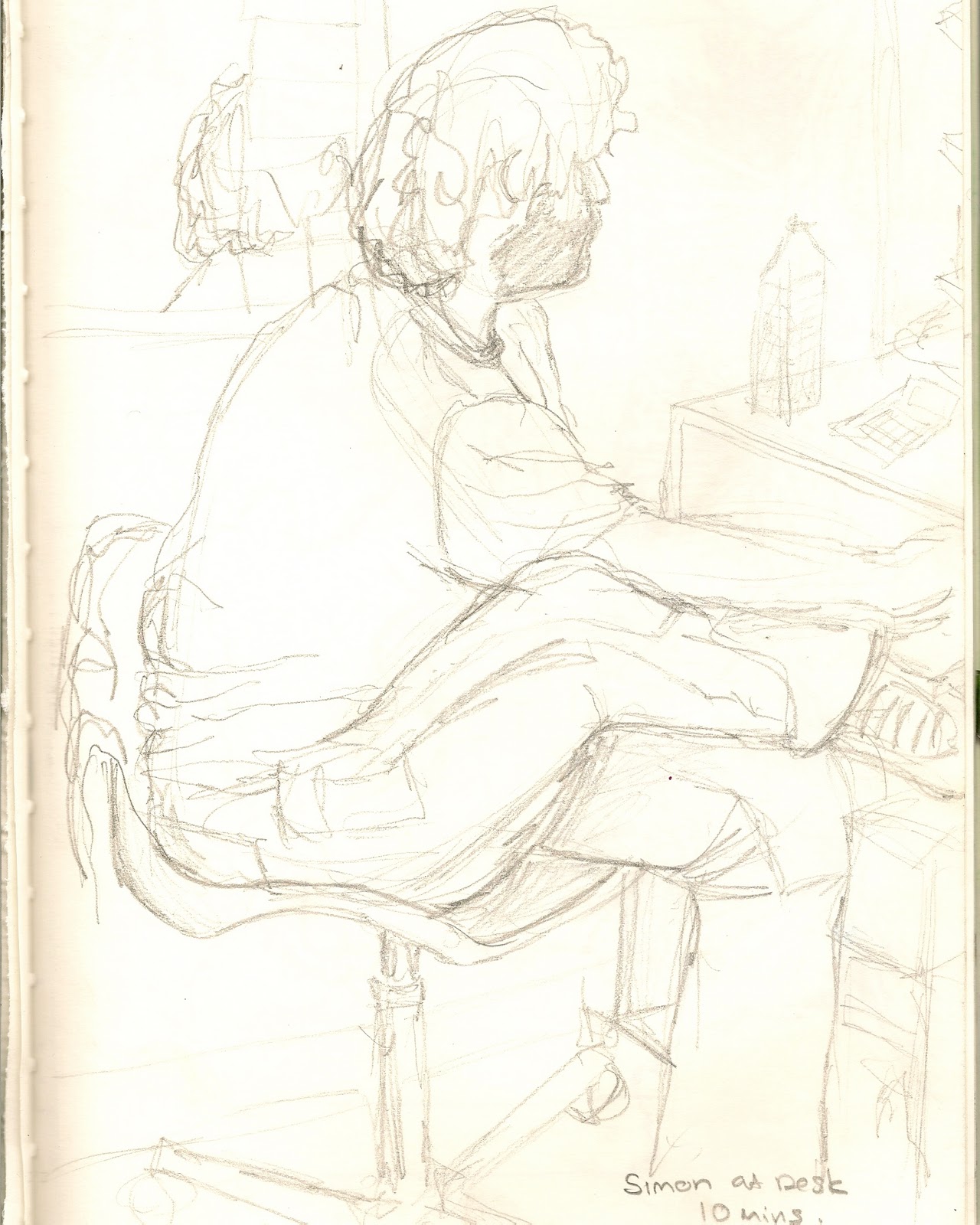
bits from my everyday sketch book:
This year i have been working on my black and white sketching and trying to stick to what i actually see as im always prone to using bright colours and abstract what i see! I like them , they do need more time and patients but i think its worth it as its a fantastic form of recording a place with accuracy and emotion combined.




Monday, 20 December 2010
Busy times,,,
wow what a busy two weeks that was! but it doesn't stop there - there is lots of work to be done over the Christmas break and i have made my geeky timetable as long as i stick to it i could even have a couple of days off before we come back for term 2!!!
Over the past few weeks i feel as though my head has been split into 3-
History and Philosophy of Garden Design / Historic Garden Conservation / Master planning
Luckily we have completed, handed in our Historic Conservation Management Plan and its already marked! I am very pleased with my well earned A , and well done to the rest of the group who all worked really hard and too got great results.
All our work will be online soon- i will post the link once i have it- the online exhibition will be all the collaborated group work and the individual Historic Conservation Management Plans of Greenwich Park, London.
Here is a little part of my document: Vision and 3 of my Key Recommendations:

the education will come the understanding of the importance of this site.
The park is to be an area of enjoyment, recreation and leisure for locals and visitors, with
introduction of select habitat areas thus creating awareness and educating all about the issues
and importance of wildlife and habitats.


Due to the amount of visitors the park receives it is important that information is provided and is
accessible to all. This can be done with the use of interactive screens: with the interactive delivery
of the information will make it fun and engaging. It will take up less space and people can find the
information that they want, in their language. The screens can be put among sculpture (see below) to
integrate is as part of an historic landscape.
-Capturing the layers of history with framed views: a picture of the same view and how it has changed
through time- with the final frame empty to see its current layer.
-For children they can imagine how it might look in the next layer and can draw how they think it will
be in 100 years time.


Le Notre (who never visited England) designed the grass parterre which were implemented
in 1662 and the giant steps that over looked it,the steps are shown in all 18th Century
prints of the park. The remains of the Giant Steps rise up to the statue of James Woolfe.
Each terrace was 40 yards wide, and on either side Scotch firs were planted 24 feet apart.
These trees were brought by General Monk from Scotland in 1664, and until forty years
ago many were standing.

The Meadow Walks
Areas where the Ancient acid grassland ispresent are being destroyed by the constant use of heavy machinery showing the lack of care and understanding of its importance.
Lowland Acid Grassland is an important habitat for nature conservation throughout the Greater London area. Lowland acid grassland develops on low-nutrient, acidic soils (pH 4 to 5.5) overlying acidic rocks or on the free draining, gravelly and sandy soils found in many parts of London. Grazing (or cutting) is needed to prevent invasion by scrub and trees this can be done once a year or every two years with the introduction of sheep for the grazing period.
The acid grasslands of Greater London, south Essex and north west Kent are an important home for a distinctive community of insects and spiders – many of which are nationally scarce. This community is collectively known as the ‘Thames Terrace Invertebrates’.

(I will post the link for the online exhibition soon.)
Over the past few weeks i feel as though my head has been split into 3-
History and Philosophy of Garden Design / Historic Garden Conservation / Master planning
Luckily we have completed, handed in our Historic Conservation Management Plan and its already marked! I am very pleased with my well earned A , and well done to the rest of the group who all worked really hard and too got great results.
All our work will be online soon- i will post the link once i have it- the online exhibition will be all the collaborated group work and the individual Historic Conservation Management Plans of Greenwich Park, London.
Here is a little part of my document: Vision and 3 of my Key Recommendations:

The Vision
The vision for Greenwich Park is to emphasise education with the promotion of its diverse history.
As a world heritage site it is to be an example of educating the local , wider community and the
world of all the historic layers the park has: From the Anglo-Saxon Burial grounds to the Royal
Observatory – Greenwich holds examples of triumph and brilliance of each time period. Withthe education will come the understanding of the importance of this site.
The park is to be an area of enjoyment, recreation and leisure for locals and visitors, with
appropriate amenities and areas for this.
The park is to demonstrate how to create areas that are beneficial to wildlife in the city with theintroduction of select habitat areas thus creating awareness and educating all about the issues
and importance of wildlife and habitats.
Visitors will once again feel that they are within a royal park.


Signs, Information and Educating
Due to the amount of visitors the park receives it is important that information is provided and is
accessible to all. This can be done with the use of interactive screens: with the interactive delivery
of the information will make it fun and engaging. It will take up less space and people can find the
information that they want, in their language. The screens can be put among sculpture (see below) to
integrate is as part of an historic landscape.
-Capturing the layers of history with framed views: a picture of the same view and how it has changed
through time- with the final frame empty to see its current layer.
-For children they can imagine how it might look in the next layer and can draw how they think it will
be in 100 years time.


Framed views within and out of the park with information of what you see within the frame.

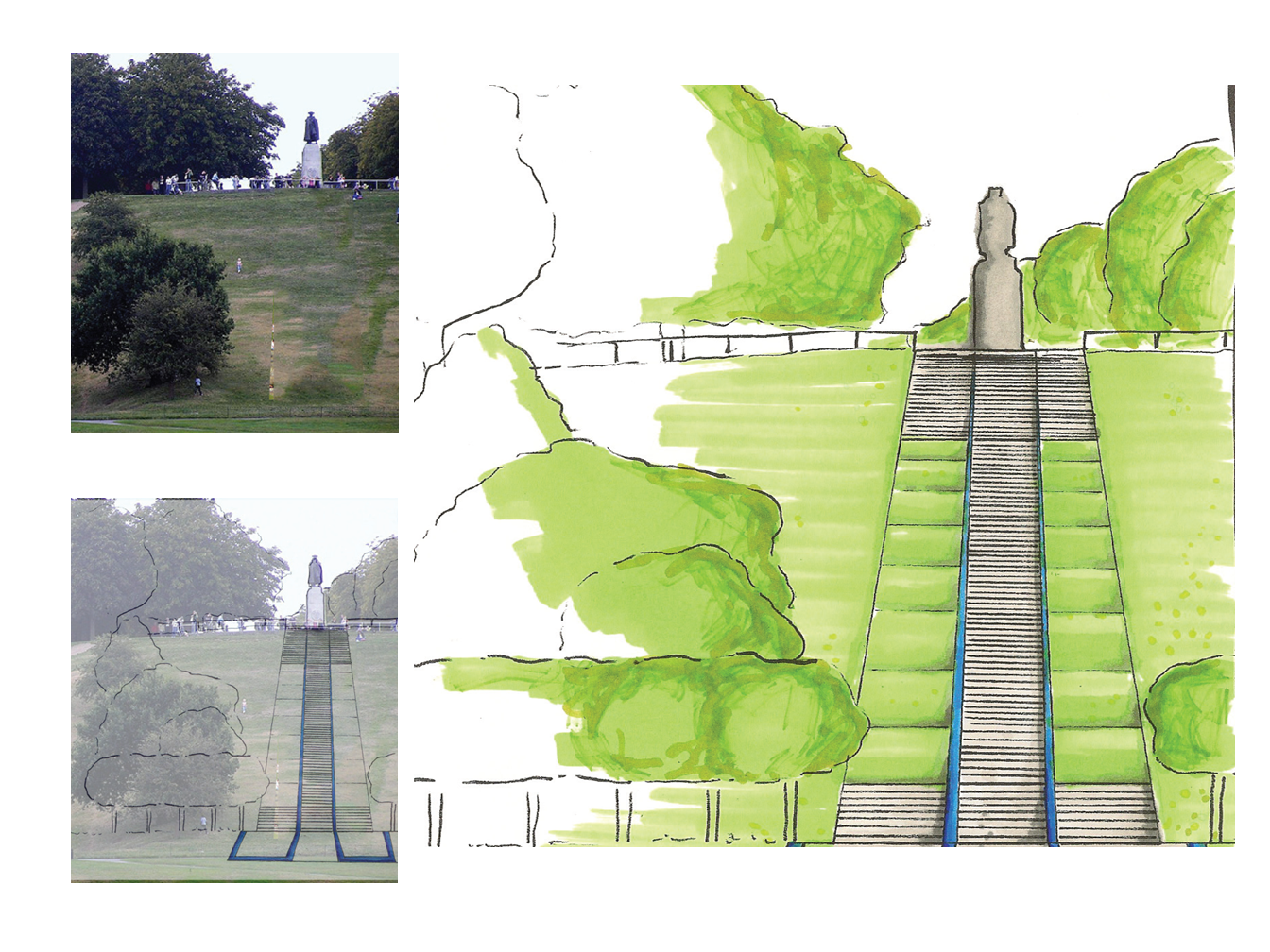
The Giant StepsLe Notre (who never visited England) designed the grass parterre which were implemented
in 1662 and the giant steps that over looked it,the steps are shown in all 18th Century
prints of the park. The remains of the Giant Steps rise up to the statue of James Woolfe.
Each terrace was 40 yards wide, and on either side Scotch firs were planted 24 feet apart.
These trees were brought by General Monk from Scotland in 1664, and until forty years
ago many were standing.
Areas where the Ancient acid grassland ispresent are being destroyed by the constant use of heavy machinery showing the lack of care and understanding of its importance.
Lowland Acid Grassland is an important habitat for nature conservation throughout the Greater London area. Lowland acid grassland develops on low-nutrient, acidic soils (pH 4 to 5.5) overlying acidic rocks or on the free draining, gravelly and sandy soils found in many parts of London. Grazing (or cutting) is needed to prevent invasion by scrub and trees this can be done once a year or every two years with the introduction of sheep for the grazing period.
The acid grasslands of Greater London, south Essex and north west Kent are an important home for a distinctive community of insects and spiders – many of which are nationally scarce. This community is collectively known as the ‘Thames Terrace Invertebrates’.

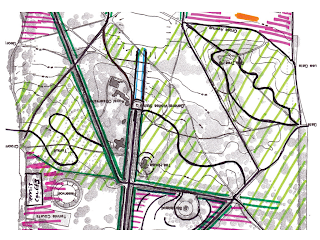
3 main areas of acid grass land will be sectioned off and left to grow and develop naturally. With the help of reintroducing species that have been loft as a result of machine mowing. There will be allocated paths that wind through the grassland to give visitors the opportunity to walk amongst a UK Biodiversity Action Plan habitat. Information about the Flora and Fauna that can be seen will be at the entrances of the walks providing education and fun to a nationally important habitat resource.

(I will post the link for the online exhibition soon.)
Saturday, 4 December 2010
snowed in!!
being snowed in has its advantages- it means i cant go to the allotment and lose hours there- when i should be getting on with my work, so i have managed to get lots done since the pretty white stuff fell-
-however i couldnt help myself- i had to go and see what the allotment looked like under the blanket of thick snow- it was beautiful!


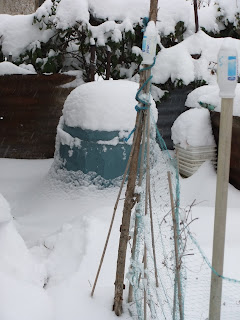


-however i couldnt help myself- i had to go and see what the allotment looked like under the blanket of thick snow- it was beautiful!
here are some summer / winter shots:


my favourite place to just sit and relax-(but not today!!)

the snow was very deep here in maidstone- or am i just very small??


we started a bonfire (any excuse) to keep warm, and i harvested some
brussel sprouts for dinner!


Oh summer days spent at the allotment- feels like such along time ago now,,,


Subscribe to:
Posts (Atom)